Creative opportunities: Boosting presence
Creative opportunities: Boosting presence
A primary goal of many experiences is to make audiences feel genuinely present within the story world, what Industrial Light & Magic's Vicki Dobbs-Beck describes as Story living45. Indeed, this sense of presence is increasingly being treated as a key performance indicator that sits alongside box-office revenue or dwell-time metrics. Multisensory elements can significantly enhance this sense of presence20, making experiences more engaging, enjoyable46 and emotionally resonant47.
Case study: Current, Rising
Current, Rising is an award-winning, location-based hyper reality opera experience created in collaboration between the Royal Opera House's Innovation Programme, Audience Labs and Figment Productions, with audience insight research by StoryFutures at Royal Holloway, University of London. In addition to a conventional audiovisual VR headset, Current, Rising featured free-roam movement, avatars, wind effects, floor vibrations and highly detailed virtual hands, allowing for a richer, more embodied experience.
Audience members reported that elements simulating physical sensations – namely blowing wind and free movement through the space – had the most significant impact on their sense of presence (see the figure below). These features fostered a visceral connection between the audience and the virtual world, enhancing the illusion of genuinely being present. Floor vibration and the visibility of avatars of fellow participants were thought to be less important, with virtual hands having the least effect of all, perhaps because there were few interaction opportunities allowing people to use their hands in the experience. Simon cautions against over-reading the lower score for floor vibration in Current, Rising:
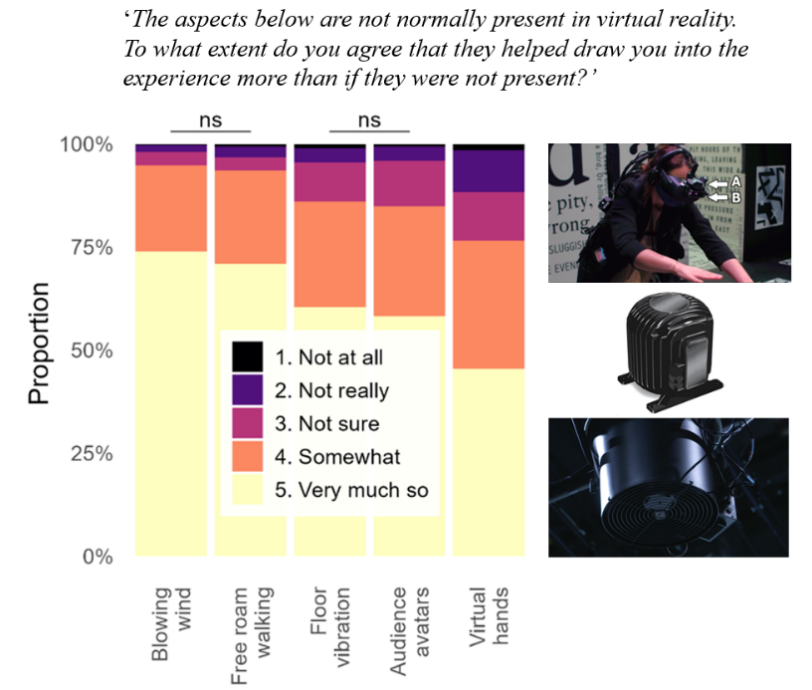
Left Figure: Depicting the frequency people responded with the different rating options to the question "The aspects below are not normally present in VR. To what extent do you agree that they helped draw you into the experience more than if they were not present?" Top-right Figure: HTC Vive Tracker used to locate head position precisely and Leap Motion controller for tracking hand position. Middle-right Figure: Illustration of a bass-shaker used to generate experience vibration. Bottom-right Figure: Rig-mounted fan. Adapted from © A. Woods et al., 2025. Going Beyond the Ordinary — User Perceptions of the Impact of Multisensory Elements on Presence in Virtual Reality at the Royal Opera House (Author Accepted Manuscript, Royal Holloway Research Portal, used under CC BY).
"Simple physical cues, like wind and free movement, do a lot of heavy lifting for presence, but to really make them impactful, they need a clear, direct connection to focal elements in the scene. The takeout is how much context/motivation for an effect matter. In [another experience], the vibrating floor was used to amplify the effect of travelling on a monorail and that was a real standout moment for the majority of our users. My feeling is that [multisensory elements] often play their part in a greater-than-the-sum-of-the-parts equation. One of the wonderful things about these sensory effects is that they are generally, relatively lo-fi and therefore, relatively cost-effective. In fact, one of the best sensory effects we ever delivered was some gravel glued onto hardboard. Stepping on that natural texture when walking into a (virtual) exterior space gives a huge boost to immersion but costs a few pounds to deliver."
— Simon Reveley, CEO at Figment Productions
The findings reinforce a broader principle: presence flourishes when multisensory signals are plausible, well-timed and narratively relevant.