In focus: Vision
The increasing availability of very large, high-resolution light-emitting diode (LED) screens is transforming our built environments, production processes and entertainment experiences. At the same time, continuing developments in VR and Augmented Reality (AR) visual presentation techniques are introducing new possibilities for immersive experiences and Mixed Reality (MR). The dominance of visual media is therefore set to continue and for good reason: vision plays a central role in most people's experience of the world.
Perhaps one of the most well-known screens is the Sphere in Las Vegas, which opened in 202379,80. It is the world's largest spherical structure (17,600 seats) with a 15,000m², 16K wrap-around LED screen. It includes an immersive sound system with approximately 167,000 speaker drivers, 10,000 haptic seats , wind, temperature and scent effects. Its debut concert, U2:UV Achtung Baby Live at Sphere, blended live music with reactive digital environments. An external facing screen, known as the exosphere, transforms the structure into dynamic animations for art and promotion.
In London, the Outernet is a free-to-enter, public walkthrough entertainment area based in the Now Building, a four-storey-tall structure wrapped in wall to ceiling high-definition LED screens with spatial audio. Content includes digital art, live broadcasts and immersive branded experiences. Outernet sometimes incorporates multisensory elements such as motion-responsive lighting installations, phone-triggered collective soundscapes and atomised scent.
Together, these examples highlight how large-scale visual technologies are being paired with other senses to reshape expectations of immersion in both public and ticketed settings.
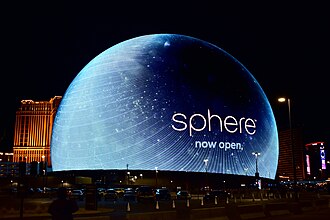
The exterior of the Sphere in Las Vegas. © Y2kcrazyjoker4, 2024.
Case study: ABBA Voyage
Opened in May 2022, ABBA Voyage is a landmark virtual concert residency staged in the purpose-built ABBA Arena (3,000 capacity) at Queen Elizabeth Olympic Park, London. The show blends de-aged (by 40+ years) sometimes 10-metre-tall digital avatars (ABBAtars) of the band with a 10-piece live band performing on stage81. ABBAtars were created with performance capture and visual effects by Industrial Light & Magic. Sound is delivered through an L-Acostics L-ISA immersive system with 291 surround speakers.
The performance is hybrid, combining pre-recorded, rendered ABBAtar performances alongside live musicians. There is a tight choreography between both sets of performers, generating a strong sense of liveness and presence82. The ABBAtars are displayed on a high-resolution LED screen and transparent staging elements, with carefully controlled lighting. It has been argued that such performances can still be experienced as live, even when the performers are digital and pre-programmed83.
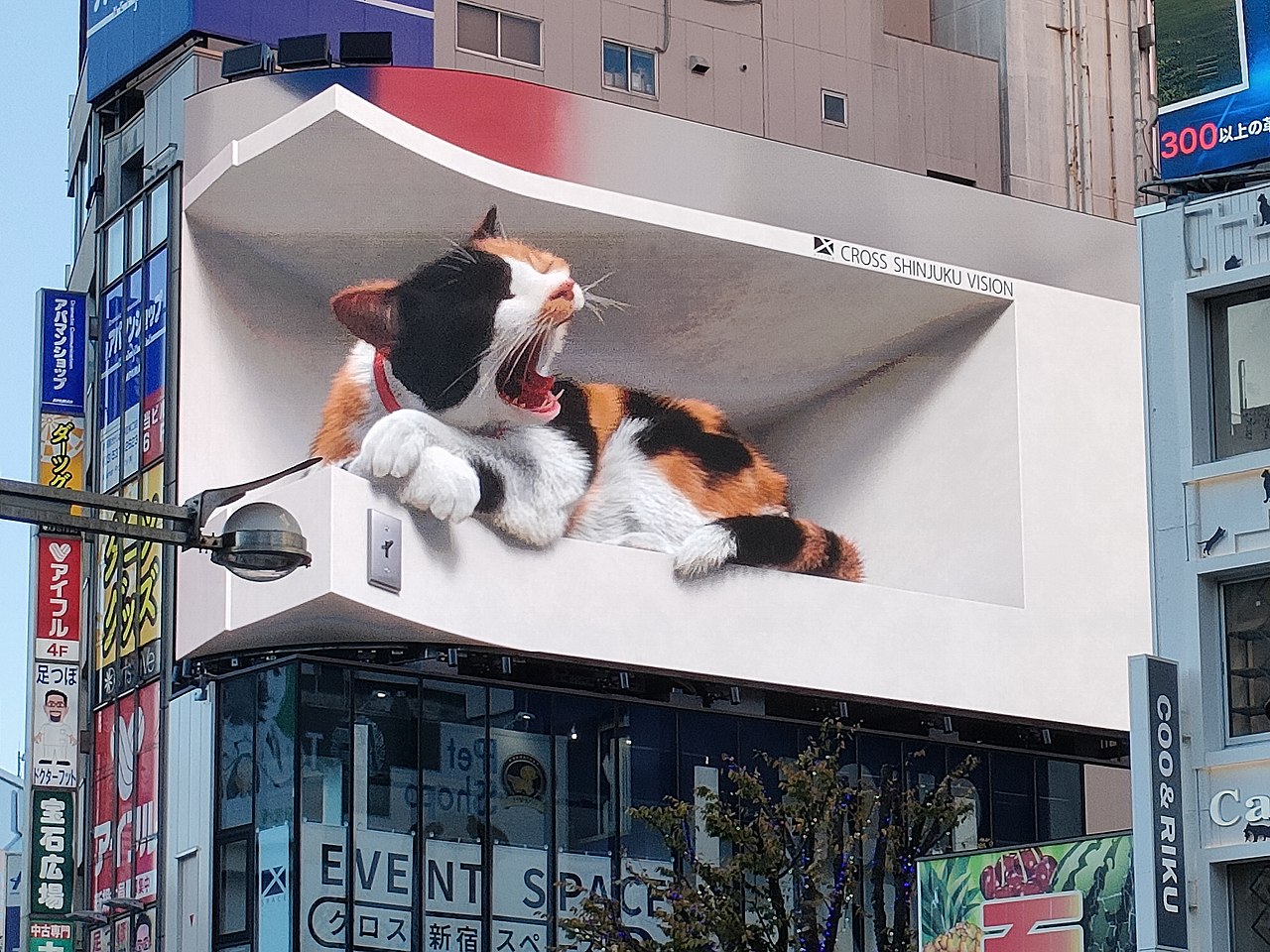
3D digital signage at Shinjuku train station. © Suicasmo, 2021, CC BY-SA 4.0.
Case study: 3D digital signage, Shinjuku train station (Tokyo, Japan)
Since 2021, a giant hyper-realistic 3D cat has been captivating passersby above the Shinjuku train station in Tokyo, not only because of its cuteness but also thanks to the anamorphic visual illusion of depth. The calico cat naps, stretches and plays in a way which, thanks to the curved 4K LED screen, makes it appear to be stepping out of its digital home84.